
Documentation with factoris.onesocial
Documentation can be fun and actively support educational processes. With factoris.one<span class="fis-pipe"></span>social you experience the perfect combination of educational methodology and technical refinement.
SKEED®
We have firmly integrated the SKEED® documentation and participation method as a working environment in factoris. This combination of a professionally sound and innovative approach with state-of-the-art technology offers you considerable advantages for your daily work.
Structured Documentation
With freely definable goal and competency trees, factoris.onesocial offers a flexible foundation to integrate both individual approaches and established procedures such as diagnostics, case understanding, or care planning. This creates common structures that can be individually extended and refined by each educator. Because working with children, young people, and their families is as individual as the people themselves, but also follows recurring patterns.
factoris.onesocial already contains numerous goal and competency trees that are directly available to you.
The SKEED® competency tree, developed in collaboration with Hamburg University of Applied Sciences and experienced practitioners from various fields, is based on the five life domains of identity according to Petzold. Over 100 competencies, structured in multi-level hierarchies, enable a resource-oriented, holistic perspective on client development.
With the step-by-step development of individual goals, coordinated action steps, precise comments, and clear assessments, documentation is created that is simple, traceable, and systematically structured - ideal for daily educational practice.
Tailored to All Forms of Support
factoris.onesocial youth welfare offers specialized documentation areas that are tailored to the requirements of individual, family, and group work. This creates specific advantages for inpatient, semi-residential, and outpatient care settings.
Inpatient and semi-residential services: Functions such as daily and group documentation, group books, or handover books optimally support work in residential groups. Even long and intensive care processes are documented clearly and concisely – for educators, youth welfare offices, and clients alike.
Outpatient services: Specific work areas for appointment documentation or individual, group, and family documentation provide space for intensive care processes, diagnostic procedures, or work with complex family structures.
Social pedagogical group work: Content and events can be documented for individual participants, e.g., reflection units that support the learning process in group training.
Educational assistance and family support: Parents and young people can clearly track and appreciate progress in the support process, creating motivation and joy for future challenges.
Whether inpatient, semi-residential, or outpatient - factoris.onesocial adapts to your individual needs and circumstances.
Usable in All Life Situations
With factoris.onesocial youth welfare, you document when and where it suits you best. Whether at the facility, in the office, on the go in the park, or on the bus - the software supports your daily work and noticeably facilitates documentation and planning processes.
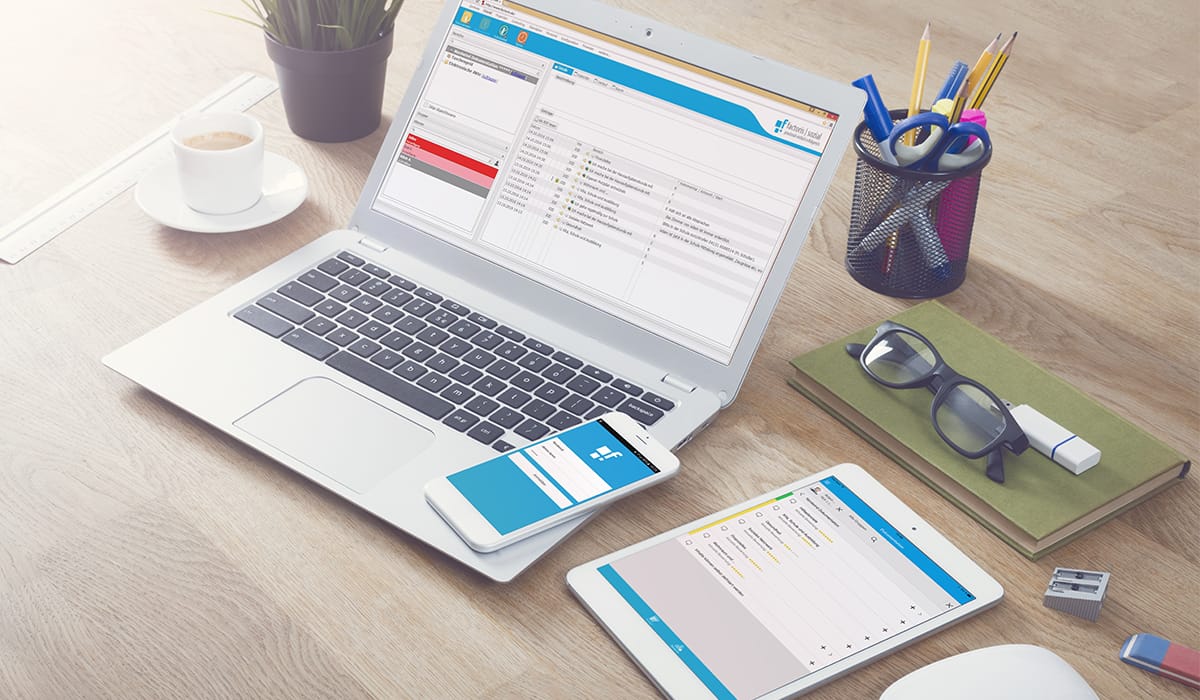
The application works seamlessly on desktop PCs, laptops, and tablets, and even on smartphones, so you always stay flexible. You can not only create documentation but also produce, edit, and print full reports and graphical representations - anytime and anywhere.
Automatically Create Reports, Logbooks, and Evaluations
Your documentation becomes the basis for detailed development and progress reports that you can create in seconds. Flexibly adapt reports to your needs by individually configuring time periods, competency areas, or progress charts.
These reports are suitable for both funding bodies and internal purposes, such as table templates for team meetings or supervisions. You can access previous reports at any time or create current ones - whether on a laptop, desktop PC, tablet, or phone.