
Access Management with factoris.onesocial
Access management in factoris.one<span class="fis-pipe"></span>social gives you secure, transparent and efficient control over access rights – through flexible, role- and time-based access control at every organisational level, complemented by permissions on individual records.
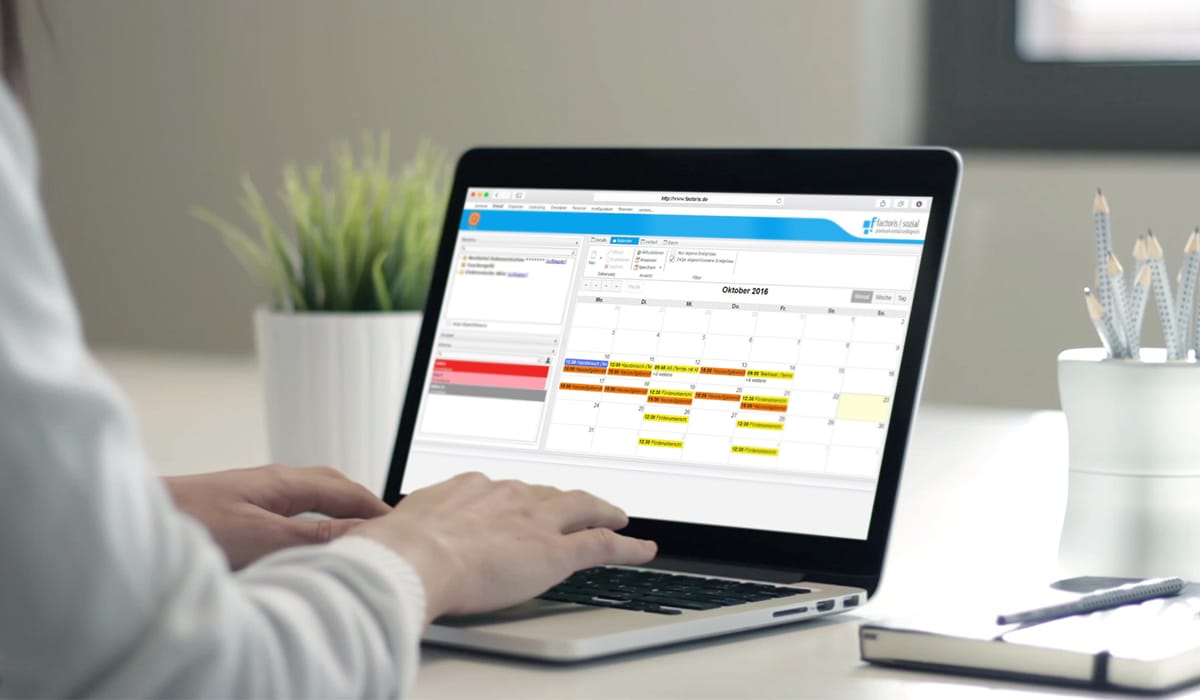
Access Management – Flexibility and Control
Access management in factoris.onesocial gives you a powerful, flexible foundation for controlling precisely who can access which data and functions in your organisation. Individually configurable permissions ensure that every employee receives exactly the rights their area of responsibility requires – and no more. This fine-grained control keeps sensitive data protected at all times.
The system is designed to reflect the complex requirements of the social sector. Hierarchical organisational units, role-based rights and time-based validity provide a clear structure and full transparency – looking back as well as ahead.
Hierarchical Organisational Units and Role-Based Rights
Access management lets you build hierarchical organisational units such as teams, departments or sites. Employees can be added at any level with a specific role and a validity period. This makes it easy to manage rights dynamically – for changing team structures, stand-ins or project-based assignments.
Every entry is historised, so you can trace retrospectively who had access, when and in which function. At the same time, you can plan future memberships that become active automatically once their validity begins. This simplifies planning for staff changes and keeps permissions up to date at all times.
Dynamic Client Assignment and Key Worker Function
Clients are assigned just as flexibly and with time-based control. A client can be assigned to an educational unit with a specific measure and a defined period. Employees then automatically gain access to the relevant client data through their role.
The key worker function completes this model by giving an individual employee full access to a client's data. For special cases such as stand-ins or observer roles, additional access can be configured – for instance read-only access to certain data or temporary permissions for external professionals.
Multi-Dimensional Rights Matrix and Record-Level Permissions
Access management in factoris.onesocial even supports a multi-dimensional rights matrix. In addition to role-based access rights, individual records can be permissioned specifically – so that certain reports, documents or notes are visible only to a defined group of users.
With this granular control you can make sure sensitive data stays protected even in complex scenarios, while collaboration remains efficient. This is particularly useful when external professionals, supervisory authorities or other parties need targeted insight.
Auditability and Traceability
The entire access management is designed for auditability. Changes are logged in detail, so you can always trace who held which rights and when. That is a real advantage not only for internal processes but also for external audits and inspections.
Thanks to historisation and logging, your organisation's permission structure remains transparent and verifiable. This builds trust and confidence – internally as well as towards external partners and authorities.
Collaboration Without Compromising Security
With factoris.onesocial you can shape collaboration in your organisation to be both efficient and secure. Precise control of access rights based on roles, organisational units, time-based rules and record-level permissions gives you flexibility and control.
Whether you are a large organisation with complex structures or a smaller team with specific requirements – access management in factoris.onesocial adapts to your needs and keeps your data protected at all times.